
The 2026 State of Heavy Equipment Dealer Service
Originally presented August 2026 to 100+ service leaders, in AED's most attended webinar of the year. Watch the full recording
An evidence-led look at how dealers are using AI in service, handling integration, and identifying the right AI opportunities
30-45 minutes with a founder, on your own work orders. Leave knowing which WIP, warranty, and wrench-time workflows AI can take on first.
Table of contents
15–20 minute read
0%1
Why now
1.1Service profitabilityWhat public dealers reveal about service margins7–14% of revenue but ~30% of gross profit1.2Technician shortageThe capacity constraint behind every service metric$2.4B a year left on the table1.3How the report was built191 conversations inside dealer service departments191 in-depth conversations1.4The 3-question frameworkIdentifying AI opportunities at your dealer
2
The AI Playbook
2.1Before work startsBriefings that make the first visit count3 dealer case studies2.2During wrench timeWhat technicians want AI to take off their plate67 technician conversations about AI2.3Closing WIP (key section)Reducing Last Labor to Close and Aging WIP2 dealer case studiesPrompt: Active WO Hit List2.4Warranty (key section)How AI is increasing warranty recovery$2.4M recovered by one dealer2 dealer case studiesPrompt: Warranty Claim Pre-Screen2.5After invoicingClosed work orders as the source of the next job2 dealer case studies
3
Next 2 years in AI for service
1.1 · Service profitability
Service & Product Support carry profitability, especially in tough economies.




Service is the outsized contributor to profitability.
Service61.5% gross margin
% of revenue
7.3%
% of gross profit
28.6%
Parts30.9% gross margin
% of revenue
17.6%
% of gross profit
34.6%
0%10%20%30%40%
Service59.4% gross margin
% of revenue
14.0%
% of gross profit
32.2%
Parts34.6% gross margin
% of revenue
15.8%
% of gross profit
21.2%
0%10%20%30%40%
Service is a small share of revenue but an outsized share of gross profit, at gross margins equipment cannot match.
How much overhead can recurring product-support gross profit cover?
At 100% absorption, parts and service gross profit covers the dealership's entire overhead — every equipment sale lands as profit, and a slow equipment year does not threaten the branch.


1.2 · Technician shortage
The industry-wide technician shortage needs new solutions, not just “recruit better.”
Most executives are focused on increasing capacity and efficiency from their existing technician headcount.
$2.4B
in potential dealer revenue left on the table each year by the technician gap
AI does not replace technician judgment. The near-term opportunity is to give technical hours back.
AED Foundation skills-gap study20,200
openings to fill every year through 2034
U.S. Cat dealers alone listed 2,037 openings for “technician” in August 2026.
Employed today227,700
Openings, 2024–34202,000
Over the decade, openings nearly equal today's entire workforce.
Mobile heavy equipment mechanics+5.8%
Farm equipment mechanics+11.0%
Growth comes on top of the openings above, which are mostly replacements.
1.3 · How the report was built
This report was built on deep conversations, not boilerplate surveys.
We spent weeks inside dealer service departments and riding with technicians. We focused on the real workflows, handoffs, and workarounds. From dispatch through close.
Who we spoke with
TechniciansService managersService writersCoordinatorsSupervisorsWarranty administratorsProduct-support leaders
How we learned
Ride-alongsJob shadowingLong-form conversationsSide-by-side screen reviewLive workflow observation
191
dealer-service conversations
67
124
TechniciansService operations
~80%
were not yet using AI in a recurring service workflow
1.4 · Choosing where to start
The 3-question framework on where to apply AI
“Our ‘AI strategy’ was sitting under our nose. We just had to listen to the people in our organization who were doing things manually.”
Leaders should ask these 3 questions of themselves and their operational service leaders.
01
Which number or outcome matters?
Begin with a result you're focused on, with or without AI.
Click an outcome to see how the three questions connect
02
What specific, recurring obstacle is preventing it?
Name the concrete, repeated handoff or missing input, not the broad problem.
Common examples
Missing or incomplete storyApproval or PO not capturedThin booking contextWarranty evidence captured lateManual search across systemsDuplicate entryNo daily WIP triageCustomer updates depend on memorySlow parts identificationSchedule lacks job contextPast jobs are hard to compareInspection findings go unworkedStatuses mean different thingsContext lives outside the DMSTechnician paperwork backlogCloseout rules vary by branch
03
Who is keeping the process alive today?
Find the person chasing, retyping, remembering, or reconciling.
Common examples
Supervisor reads WIP row by rowWriter rebuilds the customer callCoordinator chases the POWarranty admin chases photosTech searches old email and textsDispatcher reconciles the schedulePSSR reviews inspections manuallyManager audits stories at closeoutTech re-enters the same notesWriter sends every status updateParts staff identifies componentsEstimator reads old work ordersAnalyst cleans exports by handBranch leader reconciles statusesTechnical communicator retells advice
Every manual workaround is already an integration. It just uses a person as the API.
That person is often the best source for finding worthy AI automation opportunities.
A good first workflow has:
1An operating measure
2A repeated input
3One bounded AI task
4A named human reviewer
Chapter 2
The AI Playbook
The near-term AI opportunity isn't replacing the repair decision. It's making sure the right facts reach the right people fluidly, so they can do their job.
01
Before work starts
Prepared techs fix it on the first visit.
Give technicians the customer context and relevant machine history they need so the first visit has the best chance of being the only visit.
Three dealer case studies:
Case study 01
Mid-Size Midwest Dealer
38% of technician clarification calls asked for information the dealer already had.
Explore the one-page briefing the dealer attached to the booking to fix it.


Case study 02
Mid-Size Northeast Dealer
77 job-critical details were buried in ~500 recorded service calls.
Explore how the phone system the dealer already had moved symptoms and authorization limits onto the work order.


Case study 03
Large TX Dealer
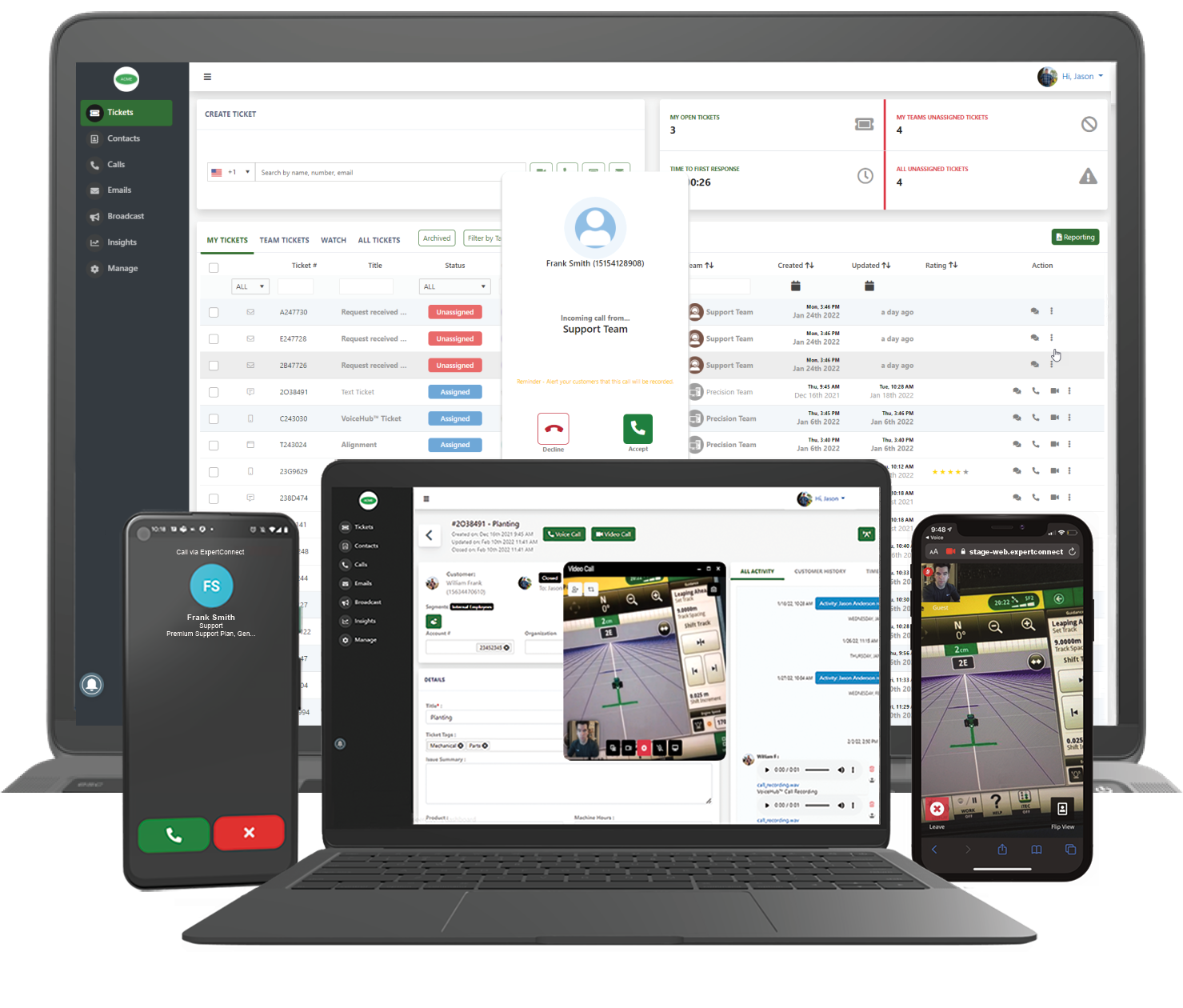
After-hours voicemails became draft work orders by morning.
A more specific voicemail greeting captured the facts AI needed to get work orders started quickly.
Keycard gives techs the context they need, before the first wrench turn.
Your systems, integrated in under 4 weeks.





1
The same briefing, on mobile.
Complaint, site, contact - in the technician’s pocket at the machine.
WO-1087
Lakeshore Aggregates
In ProgressSubmit
SummaryHistoryNotesCalls
Complaint
Machine sluggish and losing power under load during dig cycle. Engine warning on operator monitor. No issue at idle.
Cause of Failure
Enter cause of failure...
Repair Process Comments
Enter repair process comments...
Documents
Estimate - WO-1087.pdf$2,410 approved · 2 pages
2
What fixed it last time.
Another tech has solved this issue before. Keycard shows the steps + parts that fixed it last time.
WO-1087
Lakeshore Aggregates
In ProgressSubmit
SummaryHistoryNotesCalls
Relevant Past Work Orders 3
Confirms the diagnosis10 mo ago
VG turbo actuator rod binding from carbon buildup
Parts that fixed it
370-9502 Turbo Actuator · $1,912.44
Rule this out first12 mo ago
Actuator tested fine - wastegate solenoid stuck closed instead
Run the calibration test before assuming the actuator.
This machine, last visit14 mo ago
1,000-hour service - no boost issues
Fresh air filter rules out restriction.
3
Service history on mobile.
Parts, segments, stories - with lightning fast search.
WO-1087
Lakeshore Aggregates
In ProgressSubmit
SummaryHistoryNotesCalls
8 previous work orders · Caterpillar 336
Search parts, segments, stories...
786 · May 20 · 5,150 SMU · 3 parts · 8h 54m
Cleaned turbocharger actuator linkage for sluggish performance
1 segment matches this WO
771 · Apr 8 · 5,050 SMU · 15 parts · 16h
5000-hour major service and bucket pin bushing replacement
Cooling system flush, valve lash adjustment, worn lift pin bushing replaced.
704 · Nov 12 · 4,280 SMU · 3 parts · 6h 48m
Cleaned DEF injector after derate and frequent regens
Coked injector tip traced from high DPF pressure. Cleaned and verified.
02
During wrench time
Technicians want AI to remove the hunt, not replace their judgment.
“Nobody takes two hours from me all at once. I lose 10 minutes, 15 times.”
67
technician conversations
We rode in service trucks, stood beside machines, and sat with technicians as they finished paperwork.
We watched them move between the DMS, OEM software, email, text messages, camera rolls, paper notes, and private folders to reconstruct one job.
The pattern techs hate: Management needs better data, so the technician gets another box to check.
The dealership moves clerical work onto the person with the least capacity, then wonders why adoption and data quality suffer.
The better use of AI: Let the technician explain the work once. AI should structure it and check what's missing.
In 2026, clerical work shouldn't be a "hot potato" that everyone passes to the next guy. AI should take it off of everyone's plate.
The technician workflow breaks down in three places.
1
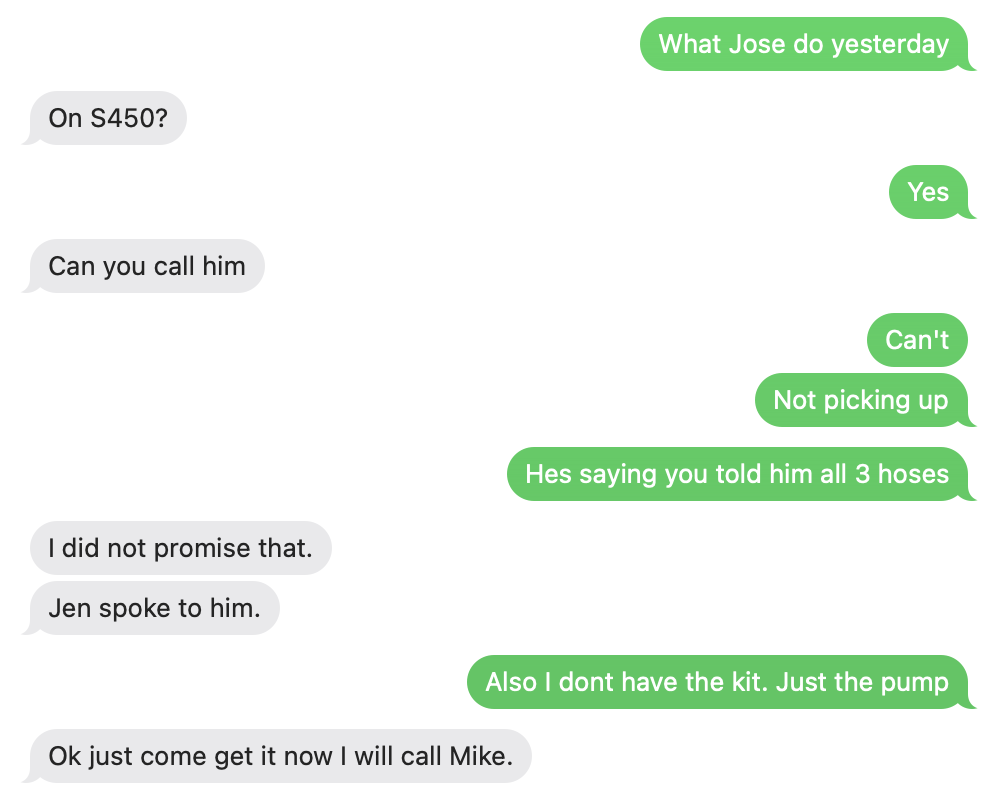
Communication
“Lots of days feel like playing broken telephone.”
The customer told the writer one thing. Parts heard something else. The tech reached the machine with a tiny part of what was written into the work order (and called the branch to reconstruct the rest).
Service ↔ CustomerService ↔ PartsTech ↔ AdvisorTech ↔ Supervisor
2
CYA
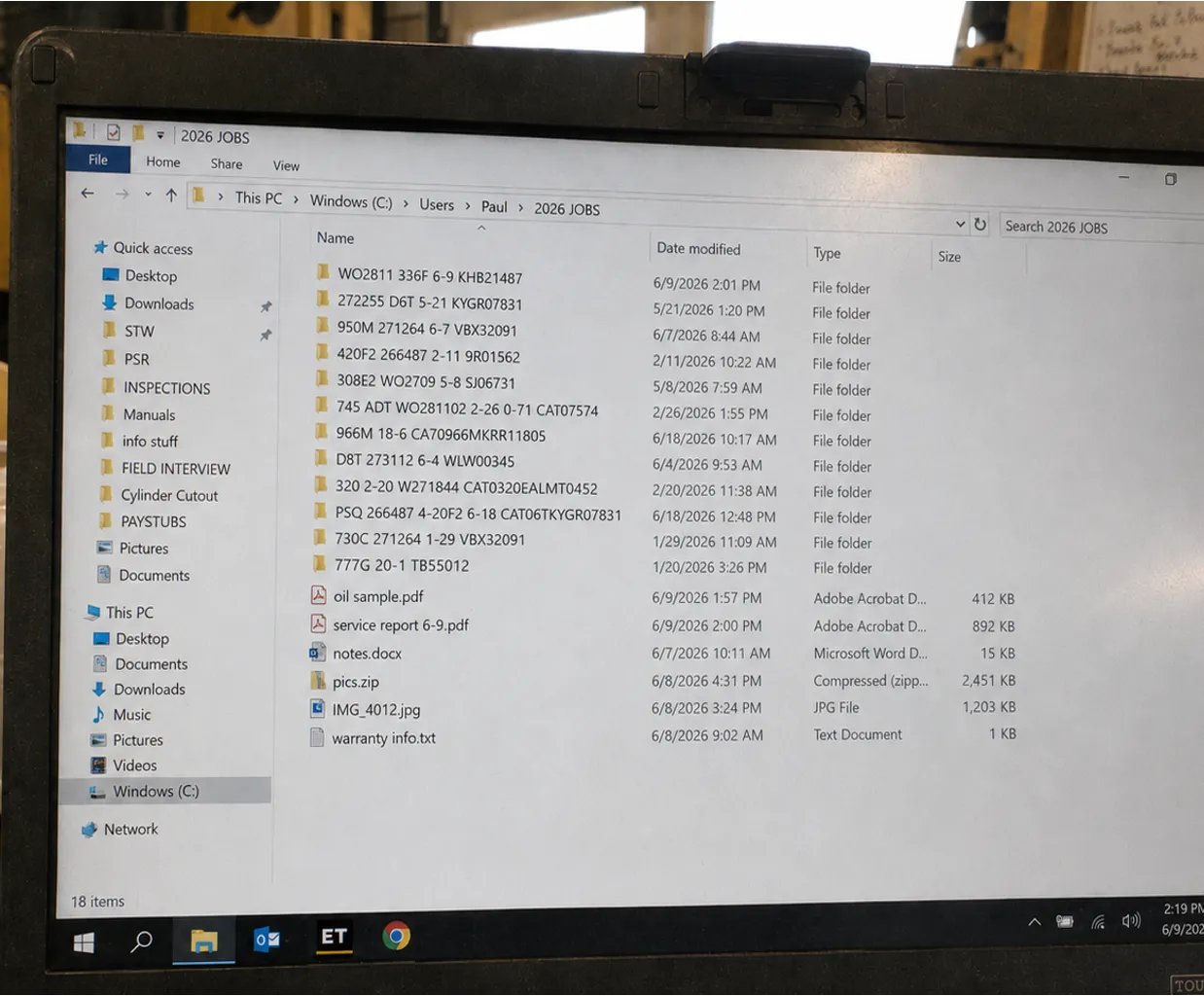
Technicians created their own shadow knowledge systems.
The old version was a binder. The current version is a laptop folder or camera roll organized by customer, work order, or serial number.
Technicians estimated that only 25–50% of what they saved privately ever reached a dealer system.
3
Warranty
"Warranty is the worst."
Technicians described being chased weeks later for a reading, photo, causal part, or OEM-specific detail that they have to puzzle out from memory.
See the warranty chapterTechnicians are already building their own AI workarounds.
1
Troubleshooting + technical search
Some technicians use AI to find a starting point, the right manual, or a specific part.
They ask for possible troubleshooting steps, sometimes share a photo, or describe the machine and symptom to find the likely manual section, procedure, parts page, or component name faster.
2
Personal email integration
2 technicians added an AI search plug-in to their inbox to find job context.
They asked questions such as: Where was this machine located? What happened with that parts order? What exactly did the estimate say? The answers existed in email, but not in a usable technician handoff.
4 jobs technicians want AI to take off their plate:
“Do the clerical work. Find me the source. Let me decide.”
1
Finish the paperwork
Explain the job once and attach the evidence. AI should draft the story, place the details into the required fields and checklists, and ask only for information that's genuinely missing.
2
Find the exact OEM reference
Get to the relevant procedure, parts page, torque value, schematic, or service letter faster.
3
Help assemble the parts list
Dealers disagree on whether the technician or Parts should own identification. When technicians own it, some spend an hour or more building a list. AI can narrow the pages and candidate parts; the qualified person still verifies fit.
4
Retrieve what this dealer already learned
Surface the few prior repairs, photos, readings, and diagnostic exports that help narrow down troubleshoot steps.
03
Closing WIP
“The repair might be complete, but the service event is only half done.”
The repair is complete.
The machine is back in operation.
The technician has moved to the next job.
But the work order is not ready to close.
Still missing:
No usable final story of the work
Labor, travel, and charges not reconciled
Customer authorization not confirmed
PO or billing requirement missing
Invoice not reviewed or released
Two habits prevent dealer service departments from closing work orders.
01
The month-end pile
“We get the simple jobs billed quickly. The 10% to 20% missing one or two things build until month-end. Some always slip through.”
The last days of the month
28
29
30
31
Where is the story?Did the PO arrive?Was travel posted?
The WIP report says what's aging. The team still has to open each job, to figure out what's missing.
02
Paperwork Friday
“Our best guys end up the busiest. Every two weeks, we have to sit them in the office for a full day just to close their paperwork.”
A repair reconstructed four days later
Mon
Repair finished
Tue
Next machine
Wed
Next machine
Fri
Rebuild the story
Camera roll
Which photo?
Notebook
Which job?
Old texts
What was approved?
The customer doesn't want to pay for "paperwork time" that happens days later. Typing notes becomes non-billable labor.
Why the invoice gets harder to defend
The longer the invoice sits, the harder the customer conversation.
Day 0
Everyone remembers
Extra disassembly, travel, or added work are fresh and justifiable.
Week 1
The proof scatters
Photos, texts, and the exact sequence get harder to retrieve.
Week 3
“I’m not paying for that.”
The machine is running; the charge now rests on a thinner story.
Two dealer case studies:
Case study 04
Large Multi-State Dealer · 2-Branch Dealer
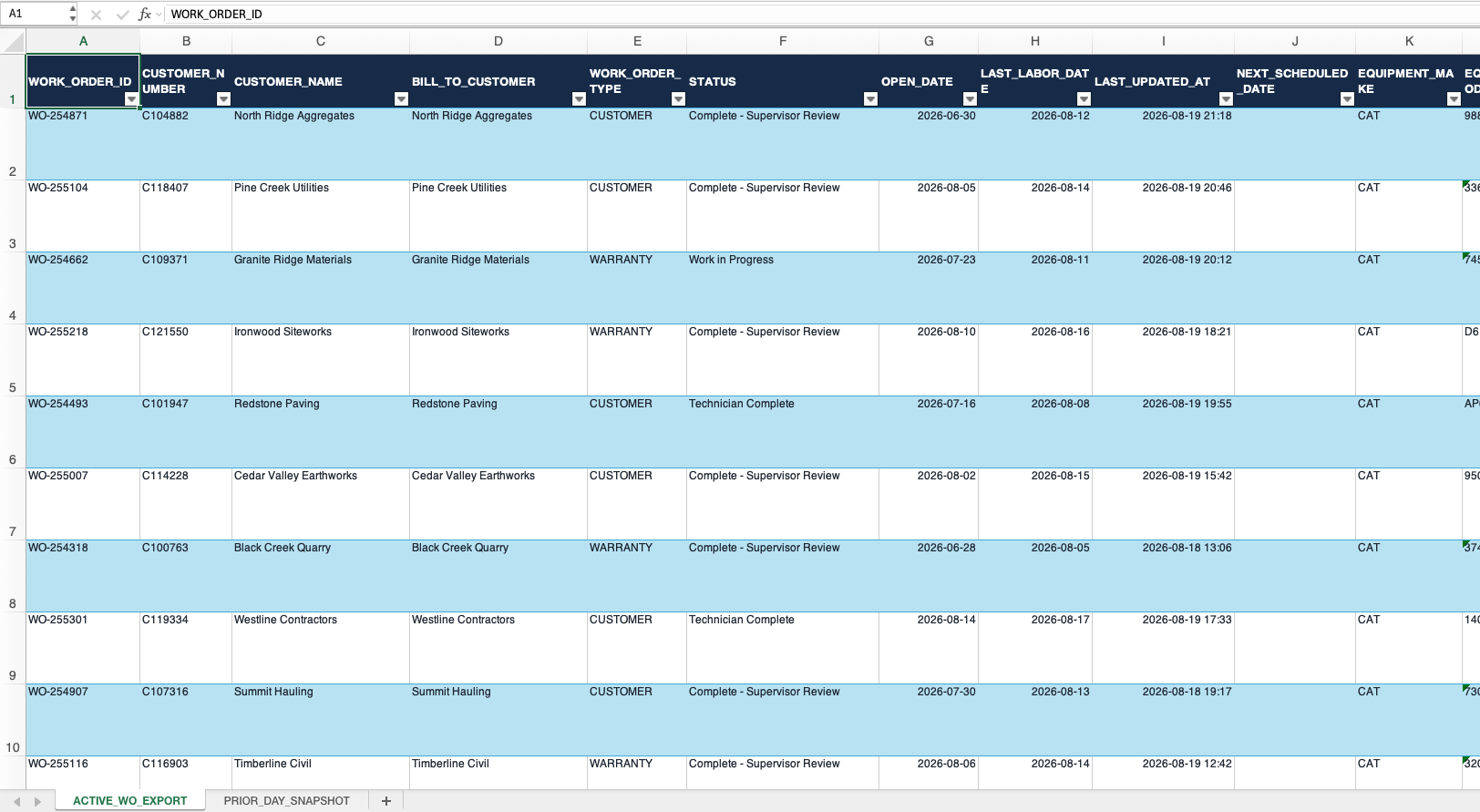
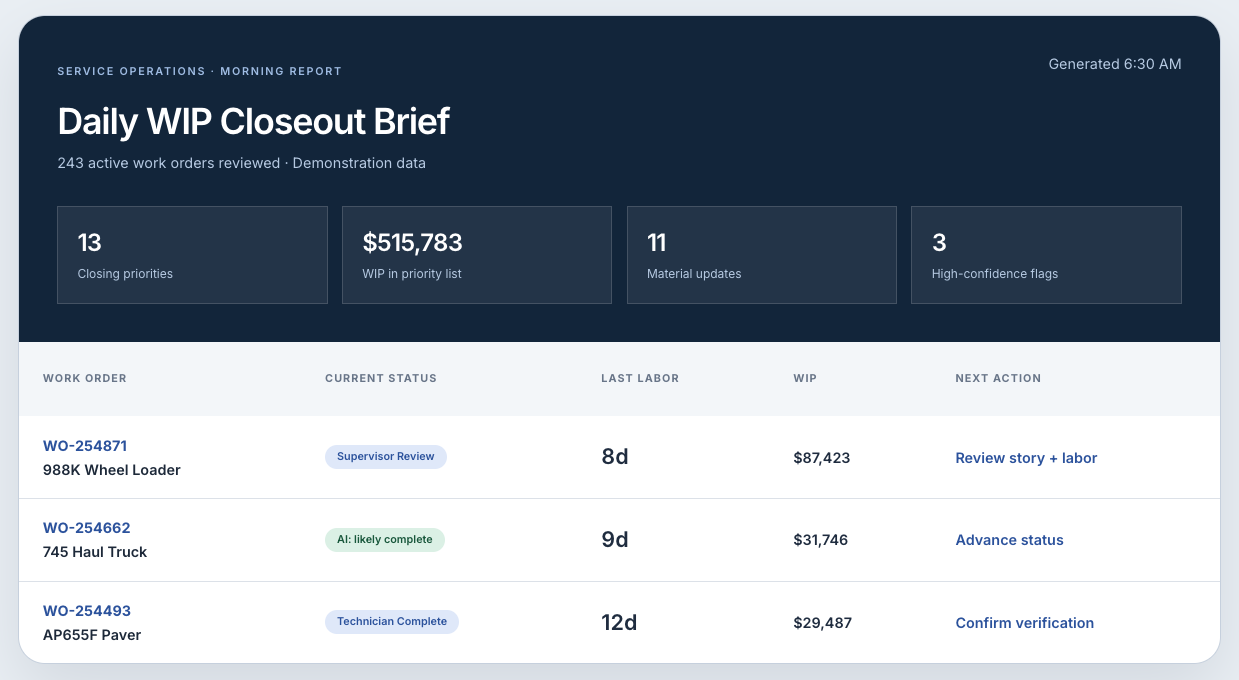
How AI turned an ordinary DMS export into a daily, closeout hit-list.
The dealers started with an ordinary DMS export. They prompted AI with closeout rules their teams already used, and asked AI to identify the work orders to prioritize closing.
Case study 05
Mid-Size Southern US Dealer
Customers got updates, before they had to call.
The dealer used Keycard to turn confirmed work-order progress into a plain-language update, whether between visits or after repair completion.
Keycard turns a technician call into a closed work order.
Your systems, integrated in under 4 weeks.
1
Technician calls in their work order story.
Talk naturally for 3-7 minutes, right after finishing the job. No typing.
AI Work Order Capture
Talk naturally through your service visit with AI.
2
AI asks what a service writer would.
Diagnostics, codes, parts, complications. Press play to hear a call.
WO-1087
Lakeshore Aggregates
In ProgressSubmit
SummaryHistoryNotesCalls
Garrett McCoy · Jun 3 · 5:00
5:00
KKeycard AI
Any fault codes on ET?
UUser
Yeah, there were a couple active. One was for low boost and the other was, uh, turbo actuator performance code. I don't remember the exact numbers, but I uploaded a photo of the screen with all of them.
KKeycard AI
Do you remember what boost pressure you were seeing under load?
UUser
Yeah, um, I was watching it on ET, only getting up to like 18, 19 PSI under full load. Should be up around 32, 34 on that engine. Way low.
KKeycard AI
Any complications that made any step take longer than usual?
UUser
The heat shield bolts were, they were pretty crusty. Two of them I had to hit with penetrant and let them soak while I was doing other stuff. One of them I ended up rounding off and had to drill out. That probably added 45 minutes, an hour to the whole deal. Other than that, it went smooth.
KKeycard AI
Do you remember about what the machine hours were?
UUser
6,200 and change. 6,200-something.
KKeycard AI
Parts. What did you install today?
UUser
Turbo actuator, the actuator mounting gasket, and then one heat shield bolt for the one I drilled out. I've got the part numbers on the slip in my truck. I don't have them in front of me.
3
The call becomes the work order story.
Clean, structured story written into your DMS. Ready to close in minutes.
WO-1087
Lakeshore Aggregates
In ProgressSubmit
SummaryHistoryNotesCalls
Complaint
Machine sluggish and losing power under load during dig cycle. Engine warning on operator monitor. No issue at idle.
Cause of Failure
Root cause: turbo actuator rod binding from carbon packed under the boot.
- Codes: E1045, CID 3464 FMI 7.
- Cal test failed - 50-55% at 80%.
- Boost 18-19 psi, spec 32-34 psi.
Repair Process Comments
- Replaced turbo actuator assembly and gasket, torqued to spec.
- Post-repair cal test passed 0-100, smooth. Boost 33 psi.
- Two heat shield bolts seized - one drilled out and replaced. Penetrant soak added time.
4
The closing checklist that drives action.
Office team knows exactly what to chase, and when it's ready to close.
WO-1087
Lakeshore Aggregates
In ProgressSubmit
SummaryClosingWarrantyCalls
1 item blocking close
14 of 15
Story
4 of 4
Complaint
Cause of Failure
Repair comments
Labor & travel
3 of 3
Segment labor7.0 hrs
Mileage64 mi · $320
Billing
1 of 2
Labor billed
Customer PONot on file
5
A single screen, focused on closing faster.
Outstanding checks and days since last labor, across all jobs.
Recent dealer activation · under one month
Median time from last labor to close
Before
18 days
With Keycard
5.4 days
04
Warranty
The repair succeeded. The dealership still ate the warranty hours it couldn’t recover.
On a warranty job, the service event has one more finish line. The repair has to be translated into the evidence, fields, codes, and wording the OEM will accept.
Voice of the technician
> 50%
of our technician conversations raised warranty, often with emotion.
The frustration wasn't “I don't want to document my work.” It was being asked to rebuild proof weeks later.
1
The question arrives weeks later
The machine is gone. The technician has touched 6 more units. Now Warranty needs the reading, failure part, or exact sequence reconstructed.
2
Warranty uses a different standard
OEM codes, required photographs, test results, causal-part rules, and acceptable wording can differ from a normal customer-pay story.
3
The repair and the claim are coded differently
The right repair can still stall on a part-causing-failure decision, segment-specific labor, a missing operation, or evidence placed in the wrong field.
“The OEM is using AI to review claims. Why aren’t we using AI to strengthen them?”
VP Service · Large Northeast US Dealer
$2.4M
Additional warranty recovery in the following year.
- Clearer evidence standards
- Earlier completeness checks
- Rejection post-mortems
The opportunity was low-hanging fruit: catch missing documentation, make the standard clearer, and give experienced admins more time for the judgment-heavy claims.
Two dealer case studies:
Case study 06
Mid-Size Plains Dealer
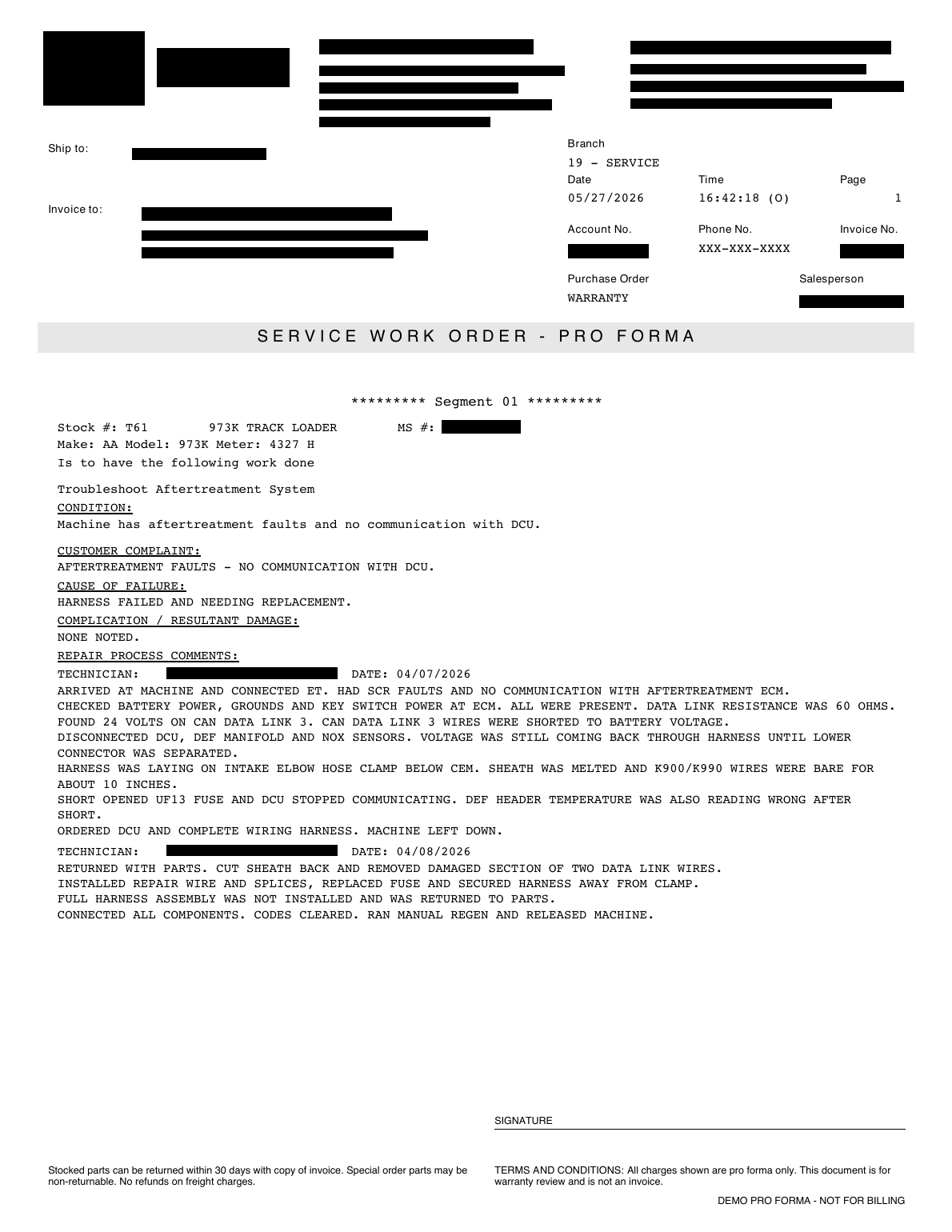
AI pre-screened the claim before the OEM did.
A pre-screen with 30+ checks caught 60%+ of the issues, when tested against once-rejected, human-reviewed claims.
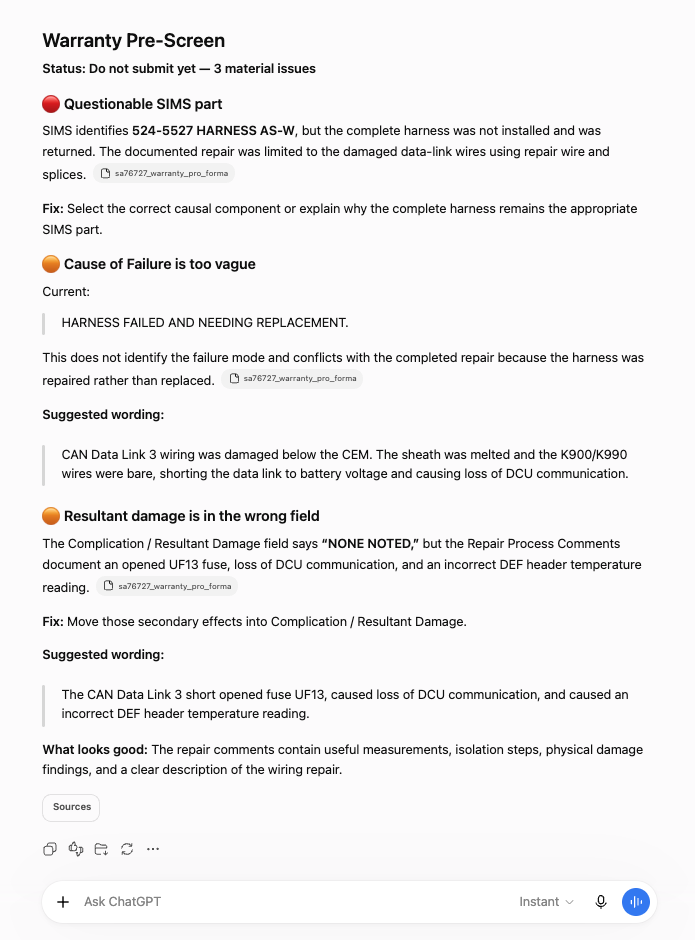
Case study 07
Large Southern US Dealer
Systematically learn from initially rejected claims.
The dealer stopped treating rejections and requests for information as one-time cleanup. AI read them all, found recurring patterns, and turned those patterns into actionable process changes.
Every rejected claim is tuition. Stop paying it twice —
Keycard turns a technician call into a claim-ready work order.
Your systems, integrated in under 4 weeks.
1
Smart warranty pre-screening. Built in.
AI applies auto-checks based on OEM and job type, so warranty admins can focus on optimizing recovery (not checking boxes).
WO-1087
Lakeshore Aggregates
In ProgressSubmit
SummaryClosingWarrantyCalls
3 items short of a claim
9 of 12
Estimated claim value $1,851
Coverage
4 of 4
Coverage windowto Nov 2026
SIMS entry370-9502
Failure narrative
4 of 5
Claim wordingsays "failed"
Diagnostics18-19 vs 32-34 psi
Documentation
1 of 3
Warranty photos0 of 5 taken
Part retainedhold until decision
05
After invoicing
A closed work order can still create the next useful action.
Once the invoice is out, AI can read completed work orders to find a pattern worth investigating or a follow-up opportunity that still needs an owner.
Two dealer case studies:
Case study 08
Small California Dealer
Six months of afterwork revealed patterns the PDI scorecard missed.
Explore how linking PDIs to later work on the same serial separated probable PDI misses from unrelated failures.
Case study 09
Mid-Size East Coast Dealer
Completed PM inspections became a follow-up queue for PSSRs.
A recommendation inside a completed inspection is not an opportunity until somebody owns the next action. Explore the pipeline the dealer built to assign that owner.
Chapter 3
The next 2 years in AI for service
AI turns unstructured stories into structured analysis. This unlocks:
More Flat Rating
AI separates the standard job from the quotable complications, so service leaders can price with evidence.
+20%
profit on one dealer’s early flat-rate jobs versus billing them hourly
— a large Pacific Northwest dealer
More Accurate Estimations
AI finds comparable past repairs and shows the estimator a range, its assumptions, and likely adders.
Why Keycard matters to the analysis
The missing link is the step-by-step detail of what actually happened at the machine.
Keycard makes it easy for technicians to write stories with step-by-step detail. It captures what the technician found, ruled out, measured, changed, and verified. Those details improve today’s story and create the labels needed to compare work fairly years later.
One detailed story serves twice
Today
Close the work order, explain the invoice, support the warranty claim.
Tomorrow
Improve estimates, find flat-rate candidates, compare repair families fairly.
Chapter 4
Put it into practice
4.1 · Integration playbook
4 ways to integrate with dealer systems
“There is no API.” “The vendor will not prioritize it.” “We tried before.” Every dealer has heard a version of these. In 2026, AI means integration isn’t the hurdle it once was.
Method
How It Connects
Use When
API
Structured records and events move directly between approved systems.
The vendor supports an API and the workflow needs dependable, frequent reads or writeback.
Database connection
Approved tables or views provide direct access to the records the workflow needs.
The dealer controls the database or has a reporting replica that can be queried safely.
Scheduled export
The DMS or ERP sends a repeatable CSV, Excel file, PDF, or report to an approved location.
The workflow can run in batches and the system already reports the data it needs.
Screen automation
Automation repeats approved clicks and typing, uses the account’s existing permissions, and stops for review where required.
There is no suitable API or export, but an authorized employee can perform the workflow in the browser.
Keycard screen automation preview
AI can now interact with a computer just like a human would.
Share with us the workflow, and which critical steps require human approval.
Automates:
Clicks
Searches
Copy + paste
Typing
Form filling
No API required.
dms.dealer.example/workordersRunning
Search work orders
WO #UnitStatus
WO-254863CAT D6T · undercarriageIn progress
WO-254871CAT 988K · powertrain rebuildReady for review
WO-254880CAT 320 · hydraulic leakAwaiting parts
Find the specified work order
Follow the defined search path
The user account can now become the integration path.
A regular employee login
Provisioned the way you'd set up a new service writer.
+
A workflow description
Click · search · copy · type · fill forms. The steps a person follows today.
=
The screen is the API.
The workflow runs on its own, under that account's permissions.
No API on your DMS? Bring it to a working session and we will show you the screen-automation path on your own screens.
4.2 · What not to automate
Where to defer to the OEM or a qualified person
Two questions before funding an automation project.
01
Will the OEM own this?
OEMs will always have better machine data. Rebuilding what they're already working on wastes budget and creates another tool to maintain.
In your systems — written down, and yours
Customer relationship
Work-order context
Technician documentation
WIP closeout
Warranty readiness
Estimate history
Build on it.
In the OEM's systems — written down, but not yours
Fault codes
Diagnostics
Telematics
Machine health
OEM customer tools
On the line: service procedures and parts pages. You use them daily; the OEM owns them. Link out — don't rebuild.
Plug into it. Don't rebuild it.
02
Can we supply AI with the context it needs?
Example: dispatch and scheduling. The schedule is in the system — the judgment behind it is not.
Recorded in the system — AI can draft the day from this
Technician locations and availability
Skills and certifications
Parts readiness
Travel time
The existing schedule
Let AI draft with it.
In the dispatcher's head — never written down, always changing
Which customer is truly at a breaking point
Which tech will succeed with this machine and customer
Which commitment can move without creating a new problem
What the branch can honestly promise
What changed five minutes ago
The human decides.
You've seen the whole service event. Now see it on your work orders.
18 → 5.4 days·median last labor to close
30-45 minutes with a founder, on your own work orders. Leave knowing which WIP, warranty, and wrench-time workflows AI can take on first.


Run by Jerry Zhang and Arjun Bali, Keycard's founders.

Advisor perspective
“What gets my attention isn’t that it’s AI. It’s that they’re attacking a problem I’ve watched this industry struggle with for more than 30 years: getting the repair into the work order while it’s still fresh, without taking the technician away from what he was hired to do.”
Jerry EdwardsAdvisor, Keycard
33 years in dealer operations · Doggett · Ascendum USA · Five Star Equipment · Louisiana CAT